
This part three of series on capital cities, exploring influences on their location and history.
There will be maps.
For the first part click here and for the second part click here.
Historical Capital

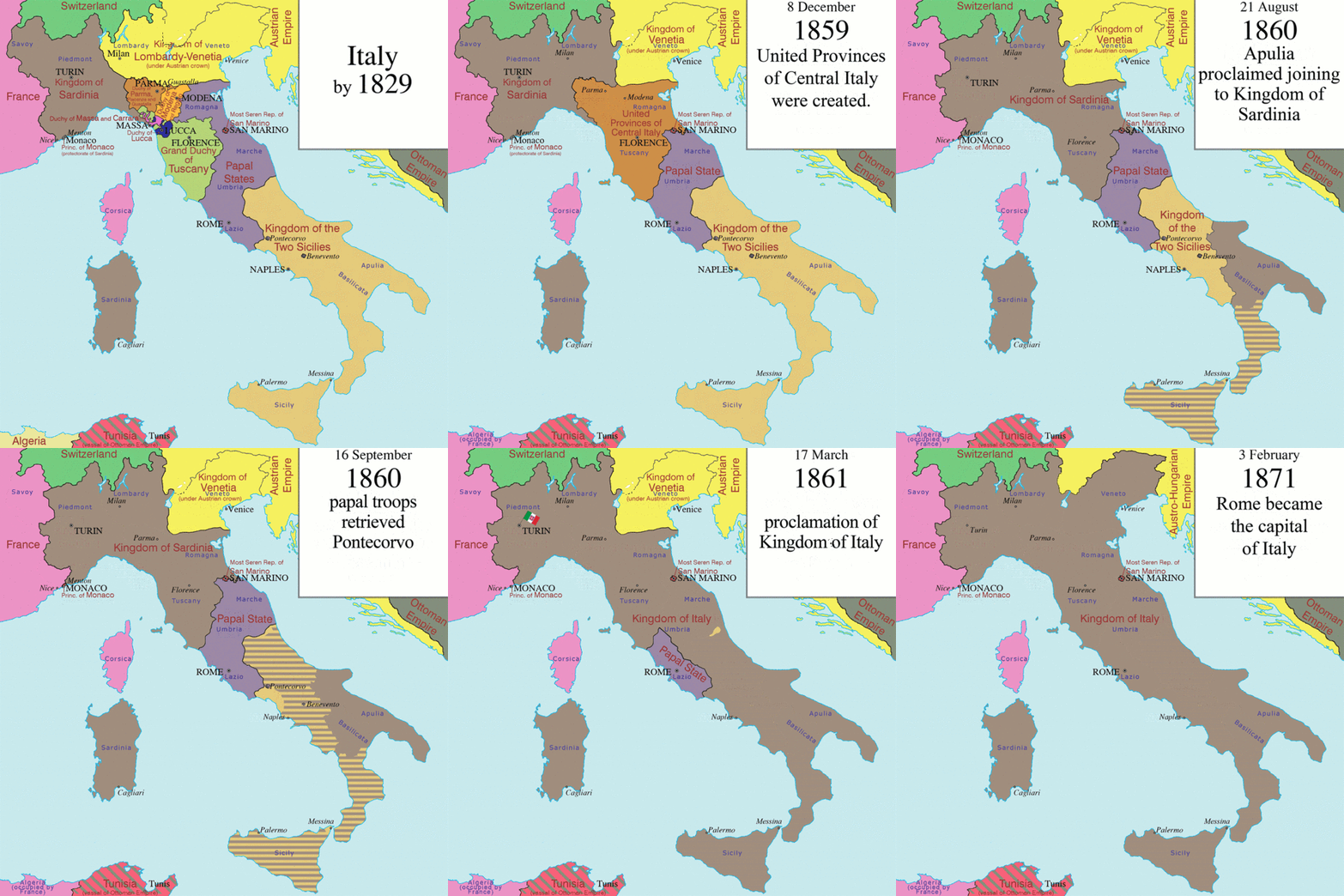
Greece is another country to hark back to its classical period to find its capital. It’s perhaps hard to imagine anywhere else but Athens being the Greek capital, but at the time of King Otto (a German as Greek King) moving the capital to here from Nafplio in 1834, it was nothing more than a town of about 400 houses below the Acropolis. Four years after independence from the Ottoman Empire however, the idea of this newly independent Greek national identity looked back to history, with the King Otto being an obsessive of Greek antiquities, undertaking excavations himself. A modern city was laid out with buildings including the Old Palace (now Parliament, 1843) and Old Parliament Building (1858) built during this period. The rest is history.
Strategic capital
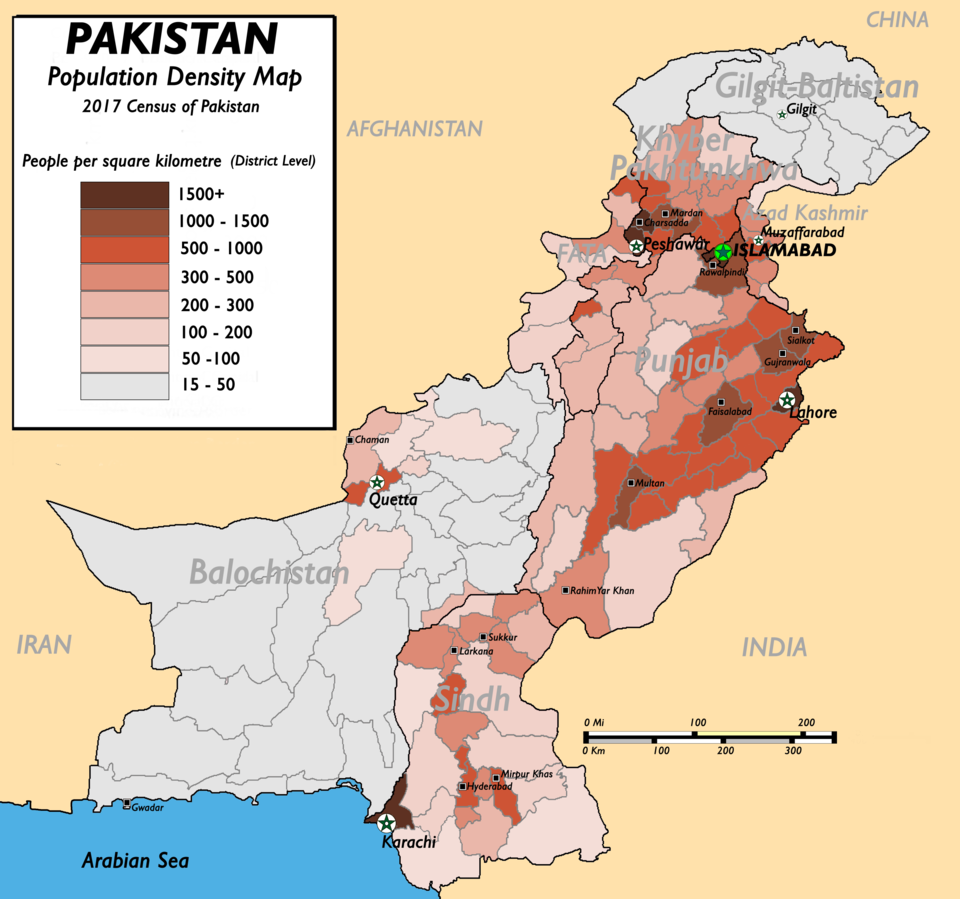
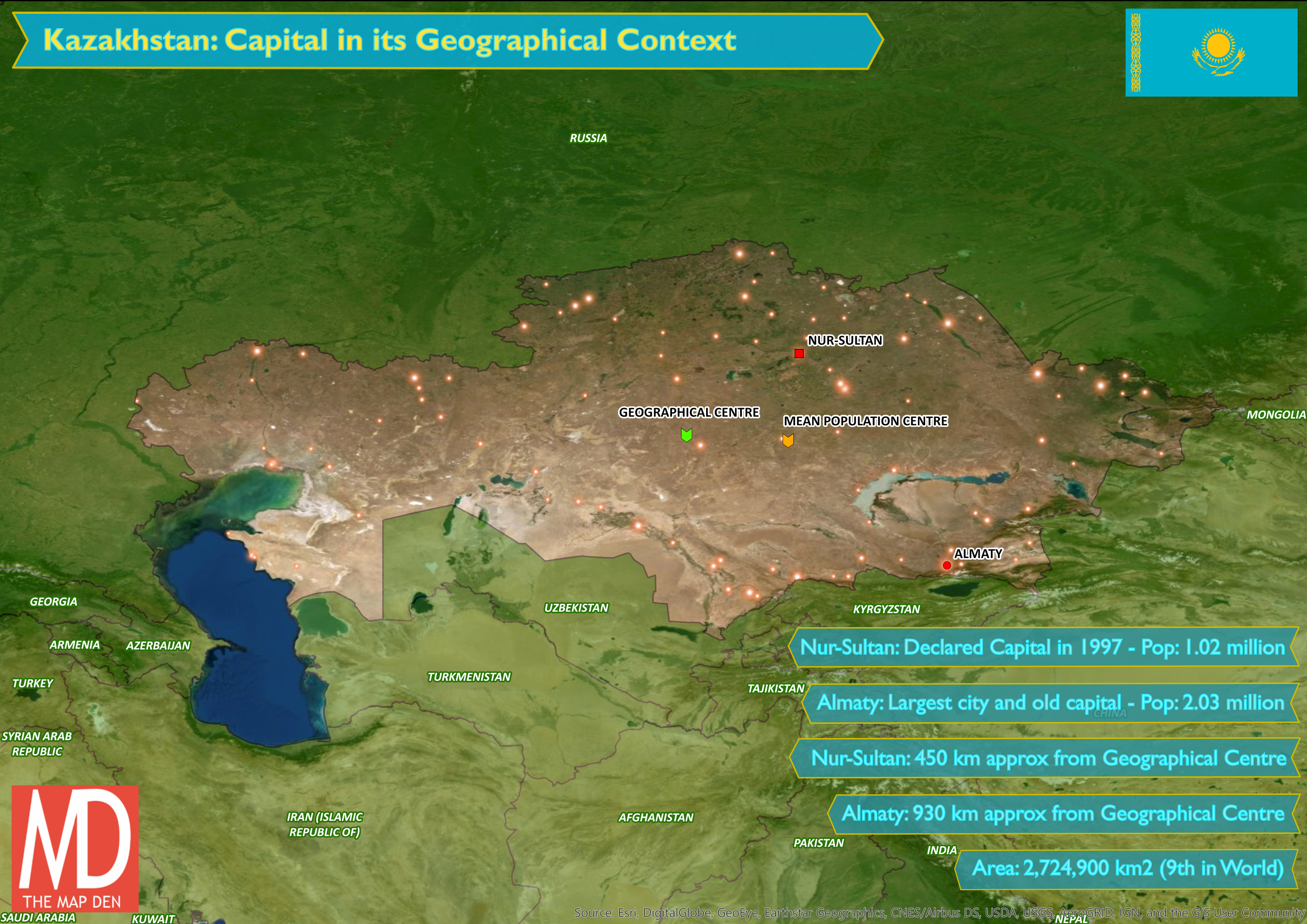
We’ve seen how Brasilia was established to promote growth to the centre of the country and reverse geographical trends – but this isn’t the only capital built to attempt this. Islamabad, was completed as a capital city in 1966 for Pakistan, in an attempt to drive economic development towards the north/central Pakistan, away from the coastal city of Karachi, which remains the economic and population hub of the country. Similarly, Astana, recently renamed to Nursultan, the name of the autocratic President who moved the capital there, hoping to energise economic growth to the north and central areas of Kazakhstan. The previous southeastern city of Almaty, was deemed susceptible to earthquakes and the Chinese border. With population growth from 320,000 in 1998, the date of this expanded city’s capitalisation, it has increased to 1 million in 2017. With economic growth and various modern architecture to match, it has been described as one of the most modernised cities of Central Asia. It is worth noting the ethnic make up and geography of Kazakhstan – in spite of its name, Kazakhs only made up 37% of the country’s population at time of independence in 1991, with a significant Russian minority to the north of country. Thus another factor, in this move is to assert Kazakh ethnic identity and control in the north of the country. For context, in 1989, Kazakhs made up 17.7% of this city’s population, Russians 54.1% – this has now switched, with 2014 Kazakhs making up 65.2% of Nursaltan’s population, compared to 23.8% Russian.
Gaborone was a planned ‘garden’ city created as Botswana’s capital city for its independence in 1964. The southeastern city of Lobatse on the South African border was the initial choice but was deemed too limited. Gaborone’s central location among central tribes with lack of association to them, as well fresh water sources and routes to Pretoria, made this ideal location for this capital. Botswana has been one of the more relatively stable, democratic and peaceful of post-colonial African countries, and it could be argued getting this capital right straight away, has played a part in this. Compare this to Nigeria, where the arguably most neutral capital was found, but only after conflict.
On the theme of conflict, one of major factors of Myanmar’s then military governments decision to move the capital from the southern city of Yangoon to the planned central city of Naypyidaw in 2005, is thought to be its closer proximity to rebel conflict. This may seem counter-intuitive, leaving government less well defended, but it is thought it could be a strategic move – a strong military presence would bring greater stability and influence to this unstable area. Some other justifications have been theorised – its more central location, and even climate change, given Yangoon’s susceptibility to cyclones and sea level rise. No official reason was provided, and it was moved with little announcement. Like many of these planned capitals, it is outside of any state jurisdiction, in a ‘capital territory’, and is notable for its low population density for its large urban area.
Economic strategy can be factor too; in the case of Tokyo, rather than trying to manipulate economic geography, use it to your advantage. In 1869, the then 17 year-old Emperor Meiji moved his royal court from the then capital Kyoto, to Edo (renamed Tokyo – ‘Eastern Capital’). I say the Emperor Meiji moved the royal court, but in reality it was the oligarchs in the royal court who held the power to influence to move it to Edo. But why Edo? Kyoto’s history of isolationist policies, while making it the historical symbol of Japanese heritage today, had left it on an economic back foot to Edo. Edo had a strategically strong position of trade and influence with western countries, leading to its increasing prosperity. The oligarchs in the royal court sought to take advantage of this, by moving the capital here to have full access and economic power with the West. Now Tokyo remains the only capital of Japan and one of the modern and developed in the world.

Capitialising on Geography
As we have seen capitals have historically evolved in the ‘old world’ as a result of geography helping them come to a usually natural prominence. We’ve seen however, usually in the ‘new world’, whether it be Washington D.C., Abuja, Dodoma, Brasilia to name a few – capitals have started in a new geography – one that has been handed to them, rather than naturally evolved. This doesn’t mean however, they have simply gone with a central geographical point in this new geography – in most occasions (e.g. many North and West African countries), this doesn’t make sense, when you have a strategic port, for example.
The responses have differed; some have moved and/or been established to take advantage of geography, whether it be defensive position or compromise as a centre point (see Canberra), compromise around ethnic lines (Abidjan). Some take advantage of historic (Athens) or economic geography (Tokyo) for political gain. Others seek to use capitals to revolutionise urban and economic geography – whether it be away from traditional cores (Brasilia, Islamabad, Astana) with new cities – some like Dodoma, even attempt challenge the concept of urbanisation itself.
This part three of series on capital cities, exploring influences on their location and history. For the first part click here and for the second part click here. Hope you enjoyed.
Happy Mapping,
David