
The double act of Music and Geography
Firstly, a very belated happy new year, as well as celebrating the first year anniversary of The Map Den! I’ve really enjoyed getting further involved in the geospatial community through this website, sharing interesting developments and content in social media, and hopefully contributing in my own tiny way on here. Geography, the study and the communication of this through maps, GIS and other geospatial forms is a great passion of mine and I believe is inherently relevant to the world around us – perhaps more than ever. Everything happens somewhere.
Another strong interest of mine is music, a passion shared by the majority of people in some shape or form around the world. Whether playing or listening, it can set a tone, pick us up, help us concentrate, give us energy etc – for whatever reason, it seems to be integral to the human senses and way of life. We all have our tastes (or lack of), but music is a gift that keeps giving, as I have discovered with age, whether it is discovering new music, old ones you have not heard before, or hearing the stories behind the bands and lyrics – without sounding too pretentious, it is an ongoing journey. However, these areas of music and geography aren’t mutually exclusive, like any cultural medium, it is influenced by geography even if in theory, music knows no boundaries.
Where’s your music?
Besides countless songs which have place names in their lyrics or title, (‘London Calling’, ‘Sweet Home Alabama’, ‘California Dreamin’ etc), geography has influenced creativity and access to music and live performances – it is little surprise that many bands and artists originate or have strong ties to large cities and cultural hubs like London, New York or Los Angeles for example. Geography has, as well as influencing the sound of bands, influenced genres and musical trends. In America, examples include New York Hip-Hop, Southern Blues and the famous Motown (coming from Motown Records in Detroit); across the pond, the phenomenons of Merseybeat, Britpop, Madchester and Europop are similar examples. We could go further into socioeconomic and cultural geographical patterns which influence musical styling – i.e. think ‘Ghost Town’ by The Specials or ‘Straight Outta Compton’ by N.W.A.
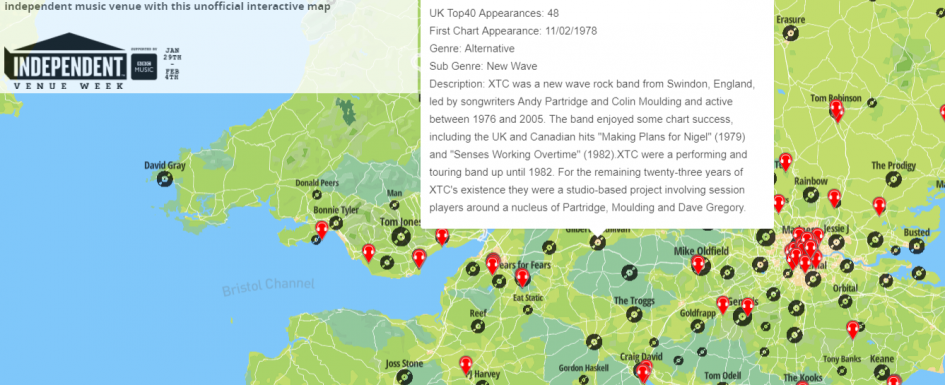
You may or may not know, but I have an ongoing project which explores these patterns, recording a geographical database of where musical artists/bands originate and form. This is a work in progress, but trends of cultural hubs and geographically influenced genres are already emerging. More about this project and trends for another day – however this upcoming week in the UK is ‘Independent Venue Week’, and so it seems fitting to tie this event in with my geographical work into local musical history (see the above map and here for fullscreen). Supported by Arts Council England and BBC Music, the aim of this week is to provide:
a 7-day celebration of small music venues around the UK and a nod to the people that own, run and work in them, week in, week out. These venues give artists their first experience of playing live in front of an audience and for fans, somewhere to get up close to artists that one day, may well be playing stadiums and festival main stages. Supported using public funding by Arts Council England, Independent Venue Week brings together these venues along with breaking and established artists, promoters, labels, media, bloggers and tastemakers to create a nationwide series of gigs at the end of January.
As mentioned, these venues provide important access to live music for the general public and the much needed opportunity for artists to showcase their talents. For various reasons, in the UK, many music venues get closed down, and with that something is lost culturally and historically from a town or city centre, and thus music risks becoming more homogenised and at the beckoned call of record labels who often place value on less risk-averse music for profit, stemming creativity and diversity. It is little coincidence that in places where there is good history of access to music venues are some of the richest musical histories. This is a time for New Years’ resolutions (if we’ve still kept them), so if you can afford to, have a good night out and explore your local music venue this year and listen to something new.
Happy Mapping,
David