
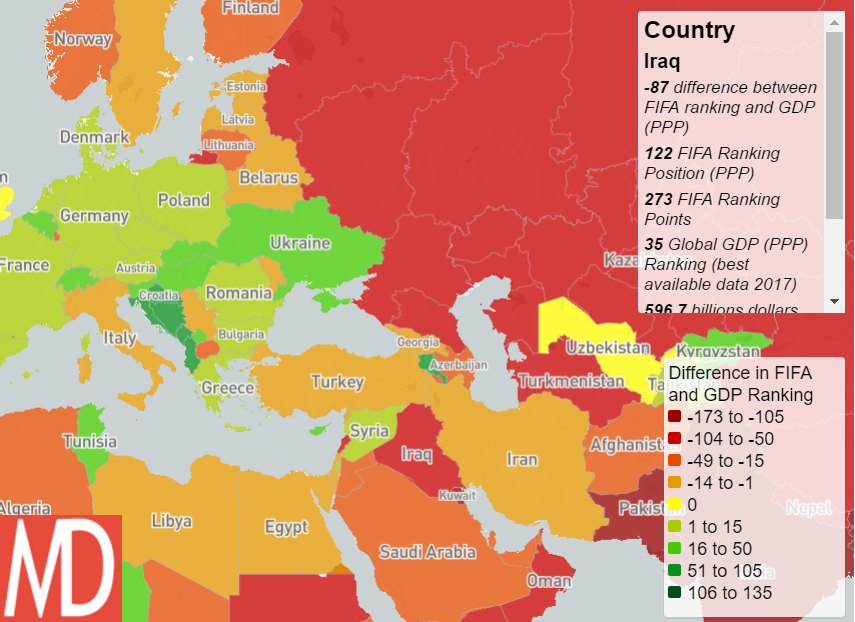
Football is perhaps the true global game, but is it played on a level playing field, particularly economically?
Most of you probably know the answer to this, but the relationship between performance and strength economically, and sporting ability and opportunity is still an interesting one. National team football is a better way to analyse this, given the great financial disparities in club football to buy the best talent and that national identity is a more static attribute. Now, I realise that some may love football/sport, some may loathe or have little interest for it. However, exploring the relationship between football and economics tells us something deeper about national identity and culture, and how independent this is of levels of economic dependency. Geographically this shows some interesting patterns and trends too.
For example, Uruguay, are two time FIFA World Cup winners, despite being a relatively small South American country of approximately 3.5 million. This is a country which ‘punches above its weight’, and this is embedded within the cultural national psyche, as South American journalist Tim Vickery sums up well, “other countries have their history, Uruguay has it’s football.” Meanwhile, Brazil’s defeat to little Uruguay in the 1950 World Cup on home soil, in what was effectively the final, is still considered not just a sporting disaster, but a national one. Football is just a game, but it is also a reflection of culture, politics and history, in ability and style of play.
So, for this study, I compared the rankings of FIFA Rankings (in February 2017), to Gross Domestic Product (GDP) (Purchasing Power Parity (PPP)) rankings. There are a few caveats; I appreciate that FIFA Rankings are often questioned by fans as whether they are best assessment of ability, but this is most reliable neutral source that is available and comprehensive. Secondly, I have run Spearman’s Rank Coefficient for statistical significance in a positive/negative correlation between GDP (PPP) and FIFA rankings – suffice to say there isn’t a statistical significance between the two, so any conclusions are limited. Nonetheless, producing GIS and mapping output for this still provides some interesting results (see below).
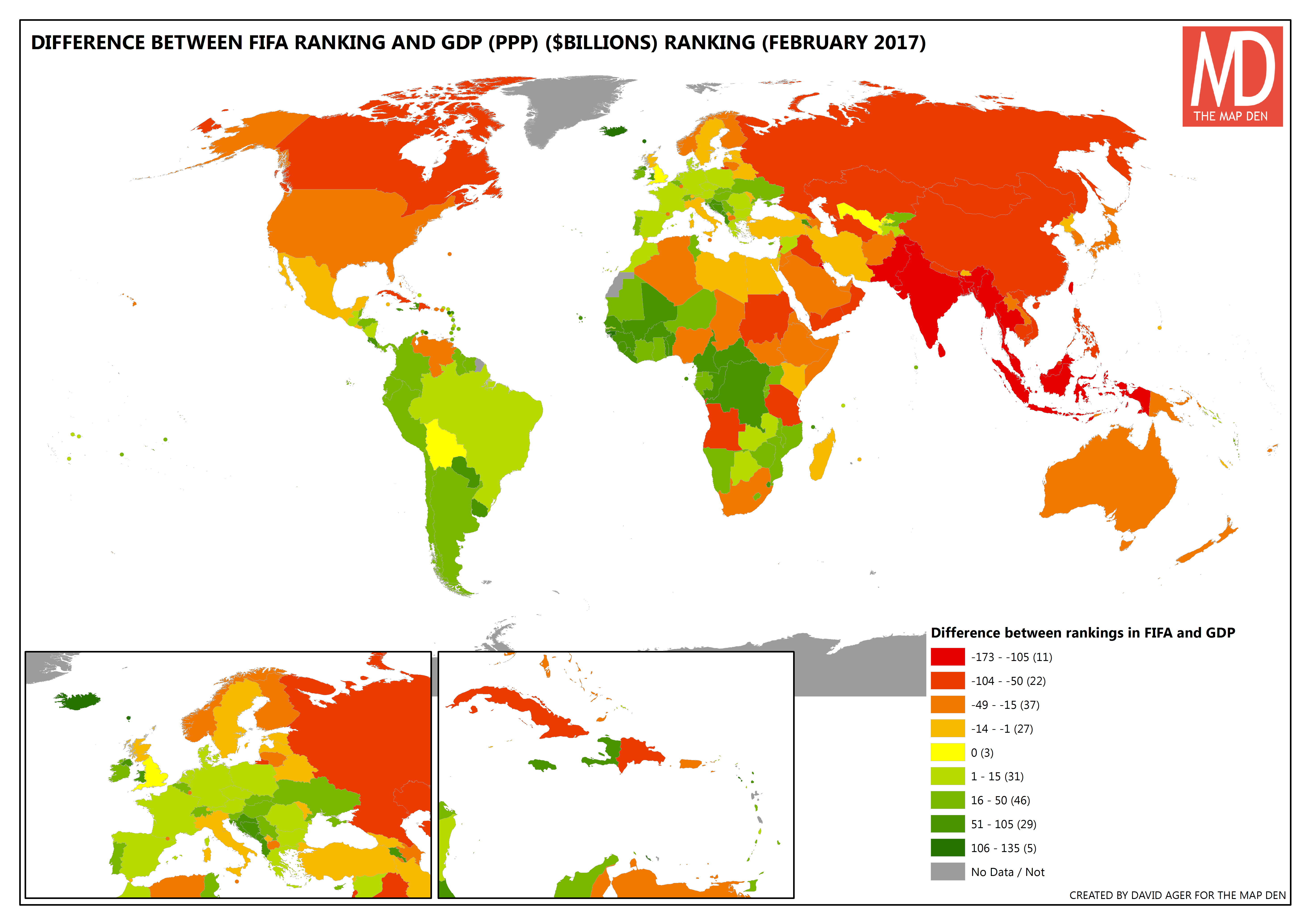
As you can see there some general geographical trends and some interesting isolated examples. Mentioning, Uruguay earlier, this is a country which particularly continues to overachieve – it is in the top ten countries footballing wise, but barely makes the top 100 in a PPP equalising GDP ranking. The same overachievment can be seen in the Balkan states of Bosnia-Herzegovina, Croatia, Montenegro, Albania, highlighting, particuarly in the first two examples how despite troubled histories, this is not seemingly a barrier to talent. For the near constant bemoaning of England’s national team, the so called ‘home of football’, they are, well, exactly where they should be, according to economics and this map (minus the other home nations separate figures). Meanwhile their near neighbours, Wales, Northern Ireland, as well as Iceland and Faroe Islands vastly overachieve.
In regional terms, there are most of the Western European countries, who continue their historically high performance, despite their size, and their history and political stability cannot be discounted in this. Meanwhile, South America and most of sub-Saharan Africa are the great overachievers, particularly given the greater economic challenges faced here compared to Europe. This is in contrast to the majority of Asia, which under-perform according to this map, particularly notable in the economic powerhouses of India and China, where football has not had the same level of cultural significance historically. Much the same can be said about USA, but the underachievement of Russia is perhaps somewhat surprising, despite the contributions they have made to the game. Zoom in close, and one can also see how general tiny island nations overachieve too.
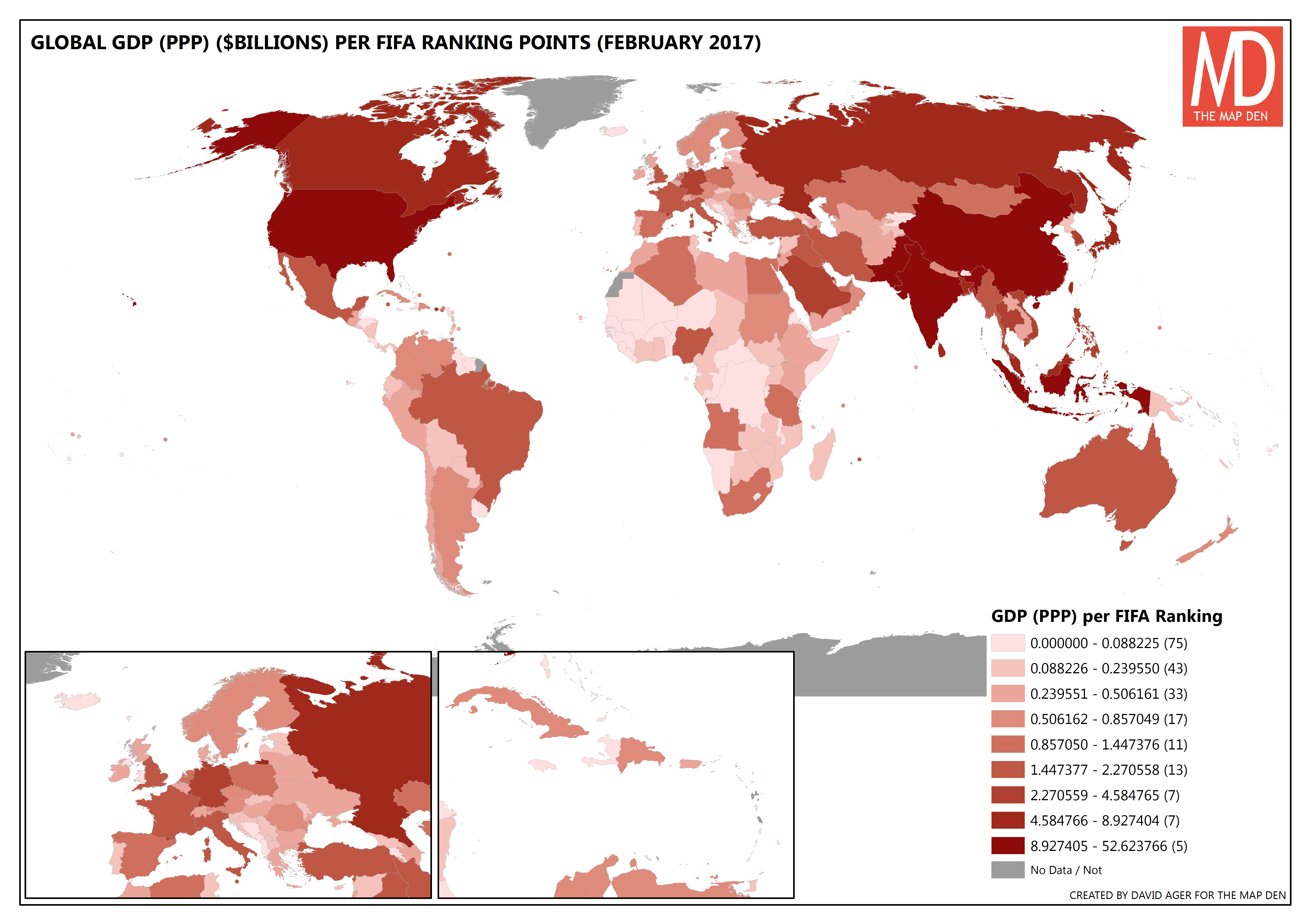
The reasons for these patterns are beyond the scope of a mapping/geospatial website. One could suggest the history of street/favella football, the cultural and colonial influences on spread and take up of the game, coaching and tactical innovations, politics, environment etc. Some of this is probably talent and luck; as a Wales fan, I realise how currently the influence of one world-class player (Gareth Bale), as well as a team to workaround him, can see the over-achievement of a nation. Conversely, as a Swindon Town fan, I’ve seen how bad luck and financial mismanagement can lead to current underachievement. And this doesn’t even consider the women’s game, where gender opportunities may be reflected more, e.g. USA women’s team perform far better than their male counterparts.
However, these are questions for sports journalists, philosophers, sociologists and historians to ponder. What I find interesting is the process and goal of discovering and mapping these patterns, and what they reflect and uncover about the world.
Happy Mapping,
David
You may want to explore this data in more detail, but how you may ask? To explore more please check out the interactive map at the top of this page, or for a full screen version please click here.
PS: If you enjoyed this, please subscribe and share if you haven’t done so. Let me know what you like and what I can improve in the comments. I hope to make more interactive web application maps, and maybe go through the process of how I made this in a future post.
Thanks, great article.