
Croeso! Fáilte! Degemer mat! Failt ort! Dynnargh dhis!
If you managed to work out the languages in the above greetings without Google, congratulations! For those who needed to Google (including myself), will know for the record that the above all means ‘Welcome’ in Welsh, Irish Gaelic/Scots Gaelic, Breton, Manx and Cornish respectively. However, despite being ‘native’ languages to their respective regions of the British Isles and Northern France with long histories, they are minority languages compared to English and French respectively, with differing fortunes and histories.
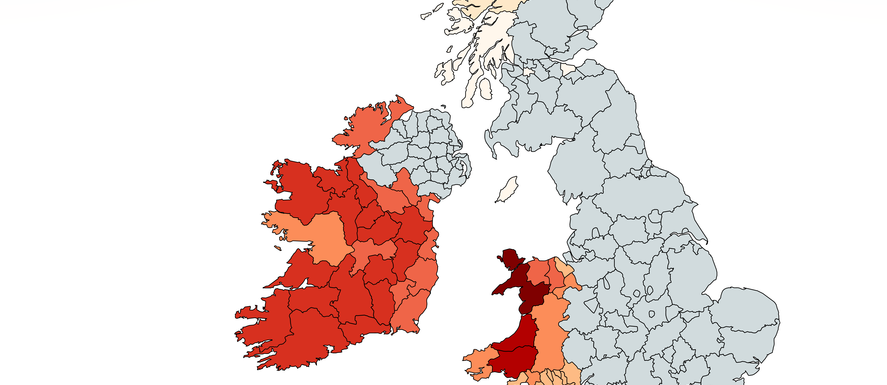
In a previous article exploring the geography of Wales, we have seen how the Welsh language is a historical link to pre Angl0-Saxon Britain and Romano-British culture, as well as being a strong cultural identifier for Wales. Linked to this language are the other ‘Celtic’ languages, though can be seen as being in two separate groups within this ‘family’. Welsh, Breton and Cornish are theorised as ‘P-Celtic’, with more Brittonic links influenced by Brits and Romans; whereas Irish, Scots Gaelic and Manx are known as ‘Q-Celtic’ which are more closely related to each other and more isolated from Brittonic influence. This history dates back over a millennia, but as we can see in the map below have had different fortunes.
The modern way

As we can see from the map above, in the modern era of English and French, these languages have had differing fortunes, particularly in a more connected, globalised world. Even then, this map only displays those areas which have ‘some knowledge’ and can hold a conversation in this language. Those who speak these as a first-language are likely to be of a smaller population percentage. Welsh and Irish stick out as the ‘better’ surviving languages and this is down to several factors. In both, these languages are taught now side by side in schools which have helped in recent resurgence in the language. Furthermore, both countries, while having different histories, and independent Ireland and devolved Wales have held the language as part of national identity and resistance; perhaps even more so in Wales to preserve national identity whilst amalgamated in the UK.
Geography plays a role here too, whilst historically Welsh and Irish have been more ‘successful’ languages, note that the areas where the language is more widely understood. West Ireland, North West and Mid Wales, are the more isolated parts of the country, perhaps protected historically by Snowdonia Mountains or Wicklow Mountains, and its rurality protecting itself from the widespread use of English in an more urban context.
Left speechless
Another isolated region is the Outer Hebrides where Scots Gaelic is unusually high; geography plays a role here, though history plays a role too. It is important to understand, despite Scottish Nationalist propaganda, Scots Gaelic died out long ago from most parts of Scotland, and wasn’t even the primary language in many regions of Scotland just under a millenia ago. Here long gone languages like Norse, Pictish and Cumbric, as well as English were spoken, which became primary language of Scottish rulers and mainland Scotland by the 16th century. It was only in isolated areas of the country where the language ever became significant and clung on to survive.
Cornish, Manx and Breton, like Scots Gaelic, have not survived well either – their geographical isolation which helped in their evolution has become an Achilles Heel over time. Unlike the questionable funding Scots Gaelic has received for BBC Alba, (imagine a channel for a population the size of Torquay can grasp some of it), other endangered languages have not been so fortunate, Cornish and Manx even temporarily going ‘extinct’. Here, without being taught in schools, particularly met with resistance in Brittany, the language has struggled to survive.
Here, we have seen have history and geography play significant role in patterns of language history and development, as well as language’s role in regional/national identity. We only have to look at recent events in Catalonia, and the history of Spain, just as one example of how relevant these issues are today. Borders,identities and languages change, evolve, die and are born and re-born, but geography and history is there to shape it.
Happy Mapping,
David